Who was `Abdu'l-Bahá, and why did He come to the West?


Thursday, June 21, 2012

June 21, 1912 Respite in Montclair


'Abdu'l-Bahá in Montclair

Mahmud writes: "The Master went to a house rented for Him in Montclair. Since the weather in New York was hot and humid at this time, the Montclair friends had begged Him to visit. Mr Edsall's relatives were elated and grateful for the beloved Master's visit. This servant told the Eastern friends that there was a possibility that `Abdu'l-Bahá would remain there to rest from His arduous journey and overcome His fatigue, which would alleviate the many troubles and hardships of the past.
     That night the Master spoke of the Blessed Beauty's stay in Baghdád and of His Declaration, about His teaching and educating the servants of God."

Juliet writes: "On 21 June, the Master left for Montclair to stay nine days. I was with Him all day till He went. I had lunched with Him nearly every day that week. Lua, Mrs Hinkle-Smith, Valíyu'lláh Khán, and I bade Him goodbye on the steps of His house."
 _______
Mashiyat Ashraf
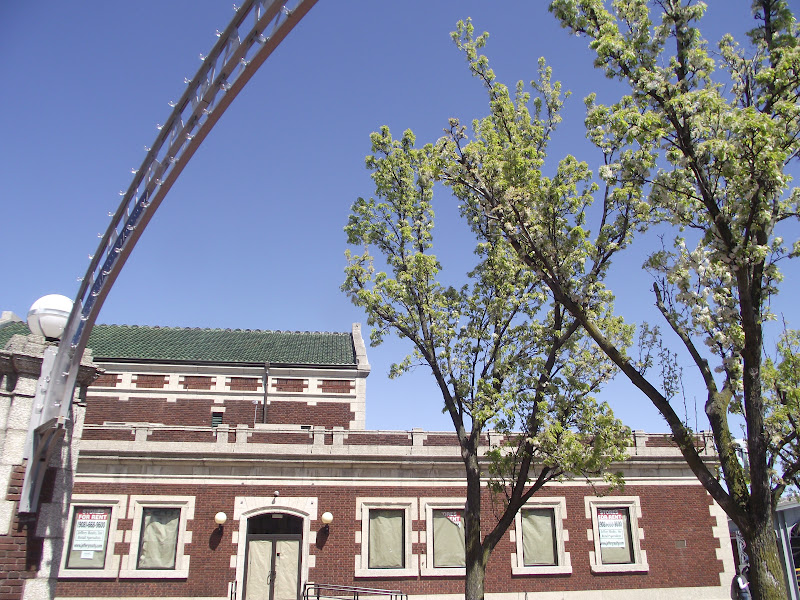
 I took the photos you see in Montclair. The first two are of the house where He stayed, the lower left is a view of Montclair from a hillside, and the lower right is of architect Mashiyat Ashraf, who took us around to see the sites of Montclair.

Going to the cooler countryside  must have been a nice respite from the city for 'Abdu'l-Bahá.

Tim and I in Montclair
 
Unitarian Church in Montclair
Train station in Montclair


Wednesday, June 20, 2012

June 20, 1912 Illuminating the hearts

New York: Preparation for Monclair; Physical / Mental Health; 
It is interesting how Mahmud's account of Juliet's painting (below) is so brief and objective, so different than her own.  This underlines how varied the experiences of individuals intersecting with 

`Abdu'l-Bahá was. But it may also signalize how the Persian men may have had a challenge seeing how important the Western women were to the Cause and to His journey. 


`Abdu'l-Bahá seems to have such a special regard for everyone--and He took the women seriously.
Mahmud writes: "As `Abdu'l-Bahá is to go to Montclair tomorrow, He bade farewell to the friends. Today He admonished and encouraged the friends, exhorting them to love and unity and to refrain from differences and disagreements. Then, at the request of Miss Juliet Thompson, He went to a photography studio where several photographs were taken. As she is an artist herself, she drew `Abdu'l-Bahá's likeness with her own hands in a few days.


Many people were present in the afternoon. `Abdu'l-Bahá spoke with a minister about the prosperity of humankind and the oneness of the world of humanity.
Mrs Smith, a member of one of the distinguished families in Philadelphia, had recently embraced the Cause and had requested a Persian name. She was given the name 
Tábandih [Light-giver] by the Master. As she had a headache, He prescribed some medication for her, saying:
You must always be happy. You must associate with joyous and happy people and be adorned with divine morals. Happiness has a direct influence in preserving our health while being upset causes illness. The basis of eternal happiness is spirituality and divine virtue, which is not followed by sorrow. But physical happiness is subject to a thousand changes and vicissitudes.
Have you heard the story of the emperor who looked into the mirror and became very sad and despondent? He said, `Oh! What a healthy and vigorous body I had but how worn it has become now! What a handsome face I had but how ugly it has become now! What graceful stature I had but how bent my body has become with age!' Thus he spoke one by one of the physical conditions of his youth and expressed his sadness at their loss. Such is the end of the physical happiness.
Another friend asked about tribulations and unexpected accidents. `Abdu'l-Bahá replied:
The chain of creation is interwoven in a natural law and divine order. Everything is interlinked. A link cannot be broken without affecting that natural order. Everything that happens is in conformity with this order and is based on consummate wisdom. Because it is decreed by God that every plant that grows must wither, all flourishing vegetation must fade away, every combination must disperse and all compositions must disintegrate. These are the necessary consequences of that universal law and of all relationships and is interpreted as divine decree.
In every meeting `Abdu'l-Bahá gives this kind of philosophical explanation to complex problems, thus illuminating the hearts."
_______

Interesting, about health and about how everything is interlinked. We live in a time when stress seems unavoidable--and of course more and more people face various maladies. Joy as remedy--how to remember that when faced with pain? 


Gertrude Kasebier
Juliet writes: "The next day, 20 June, we went to Mrs Kasebier's--Lua, Mrs Hinkle-Smith, and I--in the car with the Master.  I shall never forget the Master's beauty in the strange cold light of her studio, a green, underwater sort of light, in which He looked shining and chiselled, like the statue of a god. But the pictures are dark shadows of Him."

Gertrude Kasebier, I assume, is the photographer to whom Mahmud refers. Isn't this a great shot of her?  She was influential as a person who inspired women to become photographers--and was also known for her paintings of Native Americans. I must track down which photos she took of Abdu'l-Baha. 

Tuesday, June 19, 2012

June 19, 1912 Historic day for NY and the Covenant!


New York: "City of the Covenant" 

What a significant day! There are various accounts. Eliane Lacroix-Hopson in 'Abdu'l-Bahá in New York writes: 

THE CENTER OF THE COVENANT NAMES THE CITY OF THE COVENANT

      June 19th was an historic day for the Bahá'ís of New York. On that day, 'Abdu'l-Bahá named their city the "City of the Covenant." Also, He spoke of the Tablet of the Branch* revealed by Bahá'u'lláh in Andrianople, and proclaimed His own station as the "Center of the Covenant."
      What a highly dramatic, almost terrifying moment in history! The Son of Bahá'u'lláh, the Prophet of God for our time, suddenly lifting the veil of His humanity, appearing in the Glory of the Power of the Covenant, the Power of Creation! It happened with the swiftness and blinding energy of a bolt of lightning, transporting its two witnesses, Juliet Thompson and Lua Getsinger**, into a spiritual whirling of exaltation and fright. Juliet had been called to work on His portrait on that day. She describes a sense of "peculiar power… in the Master's steps while coming down from His room… a fearful majesty… strange flashing of the eyes…" evoking an Old Testament Figure. Later as He was sitting for His portrait, Juliet recalled the following events . . .  [But I will let Juliet tell this part of the story in her own words AP]
*In the Bahá'í Writings, Bahá'u'lláh referred to Himself as a Tree, (The Tree of Life), His children as "Branches" and "Leaves." 'Abdu'l-Bahá is entitled "The Greatest Branch."
**Lua Getsinger was one of the first Bahá'í pilgrims to Akka in 1898. 'Abdu'l-Bahá had chosen her for her passionate and irresistible nature to be a "Banner" and inspired her to teach "day and night." Though sick, until her death in Cairo 18 years later at the age of 45, she never spared herself and was given the title of "Mother-teacher of the American Bahá'í Community" by Shoghi Effendi, besides the title of "Herald of the Covenant" given by the Master.
Bahá'í News April 1976.
      In the afternoon of that day, He sent Lua down to the waiting people to "proclaim the Covenant," then a little later, He followed her and spoke on the Station of the Center of the Covenant, "but not as He had done to Lua and me."       
In confirmation of His explanations, the Master had the Tablet of the Branch read to the friends so they could hear these mighty words of Bahá'u'lláh: "Whosoever turns to Him hath surely turned to God and whosoever turneth away from Him hath turned away from my Beauty, denied My Proof and is of those who transgress." 
On that same day a copy of the book, "The Brilliant Proof," written by Mírzá 'Abu'l Fadl was received. It was in answer to Reverend P. Easton's virulent criticism of the Faith in London and his letter to America, warning people of 'Abdu'l-Bahá's dangerous influence. The Master was very pleased with the book and ordered its translation to be published in this country. 
      This Mighty Day ended like an ordinary day, with more visitors requesting an interview."
Juliet's portrait

Juliet's account is by far the most dramatic, with a focus on her own experience and the portrait she painted:

The Beloved Master's portrait is finished. He sat for me six times, but I really did it in the three half hours He had promised me; for the sixth time, when He posed in His own room on the top floor, I didn't put on a single stroke. I was looking at the portrait wondering what I could find to do, when He suddenly rose from his chair and said: "It is finished." The fifth time He sat, Miss Souley-Campbell came in with a drawing she had done from a photograph to ask if He would sign it for her and if she might add a few touches from life. This meant that He had to change His pose, so of course I couldn't paint that day. And the fourth time (the nineteenth of June)--who could have painted then?

I had just begun to work, Lua in the room sitting on a couch nearby, when the Master smiled at me; then turning to Lua said in Persian: "This makes me sleepy. What shall I do?"

"Tell the Master, Lua, that if He would like to take a nap, I can work while He sleeps."

But I found that I could not. What I saw then was too sacred, too formidable. He sat still as a statue, His eyes closed, infinite peace on that chiselled face, a God-like calm and grandeur in His erect head.

Suddenly, with a great flash like lightning He opened His eyes and the room seemed to rock like a ship in a storm with the Power released. The Master was blazing. "The veils of glory", "the thousand veils", had shrivelled away in that Flame and we were exposed to the Glory itself.

Lua and I sat shaking and sobbing.

Then He spoke to Lua. I caught the words, "Munádíy-i 'Ahd." (Herald of the Covenant.

Lua started forward, her hand to her breast.

"Man?" (I?) she exclaimed.

"Call one of the Persians. You must understand this."

Never shall I forget that moment, the flashing eyes of 'Abdu'l-Bahá the reverberations of His Voice, the Power that still rocked the room. God of lightning and thunder! I thought.

"I appoint you, Lua, the Herald of the Covenant. And I AM THE COVENANT, appointed by Bahá'u'lláh. And no one can refute His Word. This is the Testament of Bahá'u'lláh. You will find it in the Holy Book of Aqdas. Go forth and proclaim, 'This is THE COVENANT OF GOD in your midst.'"

A great joy had lifted Lua up. Her eyes were full of light. She looked like a winged angel. "Oh recreate me," she cried, "that I may do this work for Thee!"

By now I was sobbing uncontrollably.

"Julie too," said Lua, not even in such a moment forgetful of me, "wants to be recreated."

But the Master had shrouded Himself with His veils again, the "thousand veils". He sat before us now in His dear humanity: very, very human, very simple.

"Don't cry, Juliet," He said. "This is no time for tears. Through tears you cannot see to paint."

I tried hard to hold back my tears and to work, but painting that day was at an end for me.

The Master smiled lovingly.

"Juliet is one of My favourites because she speaks the truth to me. See how I love the truth, Juliet. You spoke one word of truth to Me and see how I have praised it!"

I looked up to smile in answer, and in gratitude, then was overwhelmed again by that awful convulsive sobbing.

At this the Master began to laugh and, as He laughed and laughed, the strangest thing happened. It was as if at each outburst He wrapped Himself in more veils, so that now He looked completelyhumanwithout a trace left of His superhuman majesty. Never had I seen Him like this before and I never did afterward.

"I am going to tell you something funny," He said, adding in English, "a joke".

"Oh tell it!" we begged; and now I was in a sort of hysteria, laughing and crying at the same time.

"No. Not now. Paint."

But of course I couldn't paint.

Later, walking up and down, He laughed again.

"I am thinking of My joke," He explained.

"Tell it!" we pleaded.

"No, I cannot, for every time I try to tell it I laugh so I cannot speak."

We got down on our knees, able at last to enter into His play, and begged Him, "Please, please tell us." We were laughing on our knees.

"No. Not now. After lunch."

But, alas, after lunch He went upstairs to His room, and we never heard the Master's joke.

Perhaps, there wasn't any joke. Perhaps He had just found it necessary, after that mighty Declaration, to bring us down to earth again. He had revealed to us "The Apex of Immortality." He had lifted us to a height from which we could see it. Now He, our loving Shepherd, had carried us in His own arms back to our little valley and put us where we belonged.
__________
In the early morning of 19 June, before the Master had called me to paint Him, He had spoken to the people in the English basement. On His way down the stairs from His room He passed Lua and me, where we stood in the third-floor hall. We saw, and felt, as He walked down the upper flight, a peculiar power in His step--as though some terrific Force had possession of Him; a Force too strong to be caged in the body, sparking through, almost escaping His body, able to sunder it. I cannot begin to describe that indomitable step, its fearful majesty, or the strange flashing of His eyes. The sublime language of the Old Testament, words such as these: "Who is this that cometh from Bozrah . . . that treadeth the wine-press in His fury?" faintly express what I saw as I watched the Master descending those stairs. Unsmiling, He passes Lua and me. Then He looked back, still unsmiling.

"Juliet is one of My favorites," He said.   [Wouldn't you love to be one of the Master's favorites?]
__________
In the afternoon of that same day He sent Lua down to the waiting people to "proclaim the Covenant"; then a little later followed her and spoke Himself on the station of the Centre of the Covenant, but not as He had done to Lua and me. The blazing Reality of it He had revealed in His own Person to us. To them He spoke guardedly, even deleting afterwards from our notes some of the things He had said.

Still later that afternoon the Master had promised to sit for a photograph. I had made the appointment myself with Mrs Kasebier, a very wonderful photographer, to bring the Master to her studio, but some people prevented His getting off in time. When they left, He sent for me.

"I am ashamed," He said (while I nearly died at that word "ashamed" from Him), "but I will go tomorrow. I had planned to leave for Montclair tomorrow but I will stay until Friday for your sake."

"I can't bear, my Lord," I said, "to have You delay Your trip to the country for this."

"No, I wish it," He answered.

"I have a confession to make, my Lord," I said. "I have been to Dr Grant's house. It happened in this way: he asked if I would be the bearer of his photograph to You and would I stop at the Rectory for it on my way up to You. Then he invited me to come to breakfast. That invitation I declined, but I could think of no excuse for refusing to stop for the picture. So I did go. But I stayed only five or ten minutes and his mother was with us all the time."

"Good, good," said the Master. "Going to his house was not good, but since you have confessed it, Juliet, I am very much pleased. When I look into your heart," He added, smiling, "I find it just like that mirror--it is so pure."

(Oh, please understand me, when I repeat such things it is only because they are His words to me. I keep them just to remind myself of something potential He sees in me which I must grow up to. I am not reminding myself of His praise, for it really isn't praise but stimulation. If He had been blaming me, I would repeat His blame too.

He then spoke of my teaching. "Your breath is effective," He said. "You are now in the Kingdom of Abhá with Me, as I wished you to be."

[A mystery, this. Perhaps we can experience being in the Kingdom with Him as well--on this plane and the next.  "Even as meeting Him face to face. . . ."]


Monday, June 18, 2012

June 18, 1912 Glad Tidings! Rejoice!


Eliane Lacroix-Hopson in 'Abdu'l-Bahá in New York writes: 

THE FILMING OF 'ABDU'L-BAHÁ

      "During His stay at the Ansonia, a commercial movie company had requested to make a short film of 'Abdu'l-Bahá for its newsreels. The Master replied at once, "Khaili Khub" (Very good). Some of the friends were upset and explained to Him that this film would be scattered around the country and used in movie houses. He replied: "Besyar Khub" (Most good!)
      Consequently, one day, He appeared at the entrance of the Ansonia for the making of a short film. "It was a wonderfully impressive sight, for as He approached the camera, he was exhorting Bahá'u'lláh to bless this means for the spreading of the Heavenly Cause throughout the world."
      The friends arranged for a longer film to be made at the home of Mr. and Mrs. MacNutt on June 18, and they also made a recording of 'Abdu'l-Bahá's voice chanting "Glad tidings! Glad Tidings!"
"Rejoice! Rejoice! The Sun of reality has dawned!
Rejoice! Rejoice! The New Jerusalem has descended from Heaven!
Rejoice! Rejoice! The Glory of Carmel has shone on the worlds!"
      Although unskilled handling of the camera had 'Abdu'l-Bahá going out of frame and back again, this is a precious legacy, the record of the Beloved Master in action. The film and recording have been duplicated and sent out to all countries where Bahá'ís resided at the time.
      Seventy years later, the film has been incorporated into "The Quiet Revolution," a 58 minutes major film on the Bahá'í Faith, a 1985 BBC production released on English national television and in New York City in January 1986.
      At the end of this memorable day, 'Abdu'l-Bahá traveled 40 miles to visit a Jewish friend who was sick, returning home at night utterly exhausted."
________
Though these films are available now on the internet, it is generally felt that they should not be used except in rare and sanctified situations. We (my husband and I) are working on a documentary film project for the centenary, and the guidance is not to utilize that film footage.  Still, it is a thrill to see people actually shaking the hand of the Master--and the Master walking and so forth.  More on all of this, later. 

Mahmud writes a longer version of this saga, with more description of the films: 
"At the request of the friends to take a motion picture of Him, `Abdu'l-Bahá went to Mr MacNutt's home in Brooklyn. The first scene is a hurried one, showing a ride in an automobile and the respectful reception of the friends. The second scene shows the Master walking, moving gracefully about and talking with His servants, saying:
Observe the power of the Ancient Beauty and the influence of the Greatest Name through which He has united us with the people of America in this way. If all the powers of the world had joined forces, still it would have been impossible that hearts could be attracted to such a degree and that we should be assembled in a meeting such as this with so much love, loving one another heart and soul. See what the power of Bahá'u'lláh has done! He has made the people of the East and of the West love one another. But for His power, the holding of such an assembly would have been impossible. Praise be to God that we are united and that we are of one heart and soul.
In the third scene `Abdu'l-Bahá is shown walking alone, speaking in a melodious voice, saying: `His signs are manifest, His might is established, His bounty encompasses all and His mercy is infinite.'
A fourth scene shows the beloved Master sitting among the children of the American friends, both black and white, while the Persian friends stand near Him.
The fifth scene shows a public meeting as `Abdu'l-Bahá moves about addressing the audience. Then follows a scene of farewell, with the friends shaking His hand.
The friends were very happy at this large meeting. `Abdu'l-Bahá's address was this:
Rejoice! Rejoice! The Sun of Reality has dawned.
Rejoice! Rejoice! The New Jerusalem has descended from heaven.
Rejoice! Rejoice! The glad tidings of God have been revealed.
Rejoice! Rejoice! The mysteries of the Holy Books have been fulfilled.
Rejoice! Rejoice! The Great Day has come.
Rejoice! Rejoice! The banner of the oneness of humanity is hoisted.
Rejoice! Rejoice! The tent of universal peace is pitched.
Rejoice! Rejoice! The Divine Lamp is illumined.
Rejoice! Rejoice! The breezes of the Merciful are wafting.
Rejoice! Rejoice! The joyful tidings and promises of the Prophets have come to pass.
Rejoice! Rejoice! The Glory of Carmel has shed its effulgence on the world.
    Rejoice! Rejoice! The East and the West have embraced. 
    Rejoice! Rejoice! America and Asia like unto two lovers have joined hands.
After the meeting the Master went to visit a Jewish friend, a believer, who was ill at his home 40 miles from Brooklyn. He returned to New York at night exhausted."
There is also an account in SOW, v. 3, #10, pp. 2–4.


Sunday, June 17, 2012

June 17, 1912 Degrees of devotion . . .


New York: Teachings of the Holy Spirit

Mahmud writes [on the 16th but means the 17th]:  "In the morning the Master spoke about the meeting held the previous evening at the church in Brooklyn. `This is how we establish the truth of Islam in synagogues, churches and great temples. And see what the Muslims say about us?'
He gave a detailed account of the new teachings to an eminent American author [Ward refers to a "writer of a national magazine" but neither give a name], who was to write about them and who had requested permission from `Abdu'l-Bahá to publish the work.
The subject of `Abdu'l-Bahá's talk in a public meeting today was, `However the material world may advance, it is still in need of the teachings of the Holy Spirit'.
These days He often encourages the friends to teach the Cause of God and to travel to neighboring countries. `You must teach the Cause of God', He said, `with great humility. Just as I feel myself humble before all, even before children, so must you be.' He then spoke about the various degrees of devotion.
In the days of the Blessed Beauty, I never had a desire to write. The friends even complained about it. In reply I finally wrote to Varqá [likely Mirza Ali-Muhammad Varqa] saying, `When the shrill of the Supreme Pen can be heard, what is the need of my writing?' However, in the days of the Most Great Luminary others wrote, referring to themselves, as the great sun of God."
Tomorrow (in 1912) is the day of filming  `Abdu'l-Bahá!  And after that the amazing day when NY is given the name "City of the Covenant" and the famous account of Lua and Juliet occurs. 
The picnic at Teaneck is coming up. Stay tuned for important events on the horizon! 

Saturday, June 16, 2012

June 16, 1912 His Ark still floats!


New York: Juliet's disappointment re. Percy Grant

Lincoln Park, Chicago
(image reminds us of how
tangible the Master was
to those who were with Him)
The following excerpt from Juliet's diary reminds us of how many sub-plots related to individuals were going on during the Master's visit:  "Tuesday, 16 July, the day proposed for the yacht trip up the Hudson, was a day of crushing disappointment. In the morning I awoke thinking: Today great things may happen for Percy; miracles may happen! Still, an instinct made me uneasy.
     As soon as I reached the Master's house I asked if Dr Grant had been heard from. No word had come, Dr Faríd told me, and really the Master ought to know in order to arrange His day's appointments. "You had better telephone, Juliet."
     I went to the corner drugstore and called the Rectory, only to learn that Percy was still in Greenwich. I called him in Greenwich.
      "Oh, Juliet." He sounded bored. "I have been meaning to telephone you all morning, but one thing after another has prevented. No, I am sorry, tell 'Abdu'l-Bahá how very sorry I am, but I cannot arrange the trip for today. Mrs Flagler was in town yesterday and it didn't agree with her and she isn't well enough to go today."
     "I am very sorry," I murmured, so shocked I could scarcely speak.
     "When does the Master leave New York?"
     "On the twenty-second."
     "On the twenty-second? I hope it can be arranged before them."
     "I hope so."
     "How did the supper go off the other night?"
     "What supper?"
     "The supper you had for the Master?"
     "There was no supper."
     "Why, I heard you talking about 'provisions' over the telephone with Mrs Morten."
     "That was only fruit and a cool drink. The Master just paid us a visit. I asked you to come in."
     "Well, I didn't feel that I could. I thought you were going to sit around a table and that all those Persians you had asked would fill it up, and that woman you invited at the Master's house. It makes me shudder, Juliet, to think of all the money you spent that day."
     "That was nothing."
     "Oh, money is nothing, I suppose!"
     "Certainly nothing compared with a visit from the Master." And I said goodbye.
     I went back to the house so ashamed I could hardly hold up my head: miserably ashamed of Percy Grant, burning up with indignation at his deliberate insult to the Master, to Him Whose "dress was the same as the dress of Jesus", an insult leveled at the Master, the real intention of which was to hurt me. Just a petty revenge on me.
     I gave Percy's wretched message to Dr Faríd without any comment; then stole off alone and wept.
     Soon my Lord sent for me. I longed to unburden my heart to Him, but Grace Krug and Louise were with Him and Grace was telling her own troubles, speaking of some unhappiness of the day before, so of course I could say nothing. I sat forcing back my tears, feeling that at any moment I might burst out crying and that I mustn't do that in His Presence for any other reason than love.
     "And now," said the Master, still talking with Grace, "the sun is out again! The sun is shining. I am glad of that. I do not like clouds!"
     Oh, what if I cry now, I thought.
     "Winds from all directions: from the north, south, east, and west--great hurricanes--have beaten against My Ark, yet My Ark still floats." Smiling, He made an adorable gesture with His hands, swinging them like a rocking boat. "One single wave has submerged many a great ship, yet My Ark still floats!"
     "Juliet," He said, turning suddenly to me, "is there anything you want to ask Me privately? Bíyá! (Come)."
     He led me by the hand into the back room.
     "Now speak. Your eyes are all speech!"
      "I only want to say that I am deeply ashamed for Dr Grant. Deeply sorry. The friend to whose husband the yacht belongs is sick and he could not get it for today."
     "It is better so," said the Master. "I was wondering how I could do it, for I am not very well today and must be in Brooklyn this evening at eight o'clock. But I would have done it for his sake. It is better; better," He ended, with a strange sweet intonation, as He returned to the other room."

If only Juliet could have read some self-help books like Women Who Love Too Much--she might have avoided some heartache!  But there was the Master, consoling her, helping her reach greater detachment. 

(Mahmud does not have an entry for the 16th.)

Friday, June 15, 2012

June 15, 1912 Spiritual Distinction


New York: In cases of disunity, both are wrong; "I desire distinction . . . "
Eliane Lacroix-Hopson in 'Abdu'l-Bahá in New York writes:  "On the afternoon of June 15, 'Abdu'l-Bahá came down to the waiting crowd of friends. He told them that while resting, He had dreamt that he was speaking to them at the top of His voice. The sound of His own voice awakened Him with the word "distinction." He explained the meaning of distinction in every kingdom of Creation. "I desire distinction for you. The Bahá'ís must be distinguished from others . . . but not of any worldly distinction. For you, I desire spiritual distinction."
Juliet writes:  On Friday, 15 June, I was with the Master alone for a while, and I brought up the name of Percy Grant. "He didn't understand You the other day, my Lord. He thinks that You teach asceticism, that the spirit and the flesh are two separate things."
     "That is not what I said," the Master replied. "I said that the spiritual man and the materialist were two different beings. The spirit is in the flesh."

Mahmud writes (dating the passage June 13 but it occurred on the 15th): "In the morning and afternoon several prominent ministers visited the Master to invite Him to their churches. They left happy and submissive after receiving the bounty of being in His presence and witnessing the effulgence of His countenance. After they left, the Master spoke to the friends and newcomers about the power and majesty of the Blessed Beauty. With great power and dignity He related the story of the last days of `Abdu'l-Hamíd [Sultan of Turkey until he was deposed in 1909] and the malicious accusations of the enemies and adversaries:
In spite of all these persecutions and afflictions, the Cause of God triumphed and the Covenant of God gained influence. In fact, even members of the Commission of Inquiry [commission sent by the Ottoman government to investigate charges leveled against  `Abdu'l-Baha by violators of the Covenant]  who every hour ordered a more severe persecution and spread a fresh calumny and who had joined our enemies and adversaries at `Akká with the aim of destroying and effacing us, were overtaken by the wrath of God while returning to Constantinople. Affairs changed; all the tyrants were debased; some of the members of this very commission were killed or murdered; and some fled away. Finally, one of them went to the believers in Egypt and begged for minimum subsistence.
The Master gave two talks in the afternoon to the gatherings of the friends. The first was about the differences among the Bahá'ís. `Bahá'u'lláh', He said, `declared that should Bahá'ís dispute, even if it be regarding Bahá'u'lláh Himself, both are wrong. He has enjoined all to turn to the House of Justice. But prior to its being established, all matters should be referred to the Center of the Covenant whom all are commanded to obey.'
After a brief rest, the Master went to another meeting where He spoke on the distinguishing characteristics of the world of humanity. His introductory words were as follows:
I was tired and so I slept. While I was sleeping, I was conversing with you as though speaking at the top of my voice. Then through the effect of my own voice I awoke. As I awoke, one word was upon my lips -- the word imtíyáz (`distinction'). So I will speak to you upon that subject."
--------------

It is INTERESTING how the Master received ideas for His talks! And the point about disunity has huge implications for the society of the future--for the justice system and so forth. How often do we experience distress and righteous indignation when our ideas are in conflict with another's. Both are wrong. How challenging the path toward unity! Some think of "peace" as placid and boring--but it is actually infinitely challenging. Perhaps in time films and computer games and life itself will reflect an avid interest in CREATING and MAINTAINING unity--so that "both" may be "right"!

Distinction. The ending of His talk is quite inspired. As you read it, you might imagine He is addressing you.  You are sitting next to Him and He is looking right at you. 

"I desire distinction for you. The Bahá'ís must be distinguished from others of humanity. But this distinction must not depend upon wealth--that they should become more affluent than other people. I do not desire for you financial distinction. It is not an ordinary distinction I desire; not scientific, commercial, industrial distinction. For you I desire spiritual distinction--that is, you must become eminent and distinguished in morals. In the love of God you must become distinguished from all else. You must become distinguished for loving humanity, for unity and accord, for love and justice. In brief, you must become distinguished in all the virtues of the human world--for faithfulness and sincerity, for justice and fidelity, for firmness and steadfastness, for philanthropic deeds and service to the human world, for love toward every human being, for unity and accord with all people, for removing prejudices and promoting international peace. Finally, you must become distinguished for heavenly illumination and for acquiring the bestowals of God. I desire this distinction for you. This must be the point of distinction among you."

How much we need to do to attain spiritual distinction!