Who was `Abdu'l-Bahá, and why did He come to the West?


Thursday, July 12, 2012

July 12, 1912 Home Visits!

New York: Visits with California friends, Percy Grant, and Howard Colby Ives; meeting at Juliet's 

Mahmud wrote [dating this the 11th but it occurred on the 12th]: "After morning prayers and meditation, `Abdu'l-Bahá bestowed His favors upon the friends and well-wishers, especially on Mrs Goodall and Mrs Cooper and other friends from California, confirming and assisting them. While He 
conversed with the friends, He also wrote Tablets in response to petitions from the believers.
     Among those who visited Him today were two eminent clergymen: one was Dr Grant, the minister of the Church of the Ascension, and the other Dr Ives of the Brotherhood Church of New Jersey. They have frequently visited the Master showing Him the utmost respect and reverence.
In the afternoon there was a meeting of the friends at the home of Miss Juliet Thompson. `Abdu'l-Bahá encouraged them to hold as many meetings as possible. `Promise each other', He said, `to visit one another's homes so that it may be the cause of promoting love and happiness.' After His eloquent discourse, sherbet and sweets were served and then He left the meeting.
     At the evening gathering at His house `Abdu'l-Bahá spoke on the degrees and station of creation, the maturity of the world and the magnitude of the Dispensation of the Ancient Beauty. The meeting lasted until dinner was ready. He sat at the table and invited all the friends from America to dine with Him. At this point a lady asked, `Up to the present time, not a single woman has appeared as a Messenger from God. Why have all the Manifestations of God been men?' `Abdu'l-Bahá replied:
     Although women are equal to men in abilities and capacities, there is no doubt that men are bolder and physically more powerful. This distinction is also apparent in the animal kingdom, for example among pigeons, sparrows, peacocks and others."

Perhaps Mahmud left off part of the explanation? 

Juliet has a different version of the afternoon meeting: "On Friday in the afternoon he stopped for me. We were expecting the Master in the evening--He was to bless our house with a visit--and at the moment Percy arrived I was telephoning Marjorie, who had offered to bring some light refreshment. Percy, sitting in the living room, heard. But I couldn't invite him, for I knew it would spoil Mamma's evening with the Master--she mightn't even come into the room.
      While I was putting on my gloves Percy produced a large and ornate pocketbook. "Juliet," he said, "here is an empty pocketbook which someone brought me from Italy. Will you accept it? I thought you might have in mind some Oriental person to whom you would like to give it."
     When we started out he proposed going up in a cab, but I objected on the grounds that it would be slow and we were already half an hour late.
     "I am bringing the Master down here at six and you would have no visit at all if we took a slow cab."
     "Well, for the matter of that, Juliet"--and his upper lip grew very stiff--"any visit I might pay would be merely an expression of affection and courtesy. As for all you could get from a visit of this sort, where conversation must be through an interpreter and 'Abdu'l-Bahá will go off into a monologue on some subject that interests Him--well, as I said, it is merely a mark of courtesy."
__________

I never saw his mouth so stubborn as when we entered the Master's house. The Master was waiting for us, sitting in the bay window of the English basement.
      "Marhabá, Dr Grant! It is a long time since I have seen you, a long time."
 But His welcome was more reserved than it had been before.
      "Well, Dr Grant," He said, after a moment, "what is the very latest news, the very latest?"
      Remembering Percy's remark, that the Master always indulged in monologue, I couldn't help smiling at this.
     "The latest news," said Percy with a wicked look, as obstinate, pugnacious and self-confident as I have ever seen, "is in the field of athletics."
     "The Olympic games?" asked the Master.
     "Yes," said Percy, surprised.
      "You know," the Master went on, "that these games originated in ancient Greece and it was a necessity of that time to develop the body to its fullest strength, the nations being constantly at warfare and the men wearing armour and fighting hand to hand. Heavy swords had to be driven through coats of mail; bodies had to be strengthened to endure the mail."
     "But explain to the Master," said Percy, very much de haut en bas, "that because of the people all centring in the cities and thus depleting their constitutions, the necessity for physical development is just as great now as it was then, though the basis is different."
     The Master answered with the utmost sweetness: "We do not deprecate physical development, for the sound mind should work through a sound body, but We think that the people of the West are too much concerned with mere physical development. They forget the need of spiritual development."
     But Percy was bent upon argument. The development of the spirit, he maintained, could not even begin till the body had first been built up; and he looked so absurdly condescending, so pompous, so sure of his power to defeat the Master, that I could scarcely control my mirth. The Master did not control His.
     "Man thinks too much of perfecting the body," He smiled delightfully, "but of what use is it to him without the perfecting of the spirit? No matter how much he develops his muscles and sinews he will never become as strong as the ox, as brave as the lion or as big as the elephant! Physically he is an animal, yet inferior to the animals, for animals acquire their sustenance with the greatest ease, whereas man has to toil incessantly, to labour with infinite pain, for a mere livelihood. So, in the physical realm, the beast is nobler than man. But man is distinguished from the beast by his spiritual gifts and these he should develop with the other, both together. There should be the perfect balance, the spiritual and the physical. A man whose ideal side only is developed is also imperfect. We do not deprecate comfort. If I could find a better house than this I would certainly move into it. But man should not think of comfort alone."
     I looked at Percy. He was still like a fighting-cock, ready for another bout. He would never give in before me, I knew, so I slipped quietly into the kitchen. When I returned the whole atmosphere had changed. His face had softened, his stiff mouth relaxed. As I entered the room the Master was saying: "When one prays, one sometimes has divine glimpses. So, when one is spiritually developed, a sublimity of nature is obtained, a delicacy of vision such as could not otherwise be found. Not only this, but tranquility and happiness are secured.
      "Do you think if it had not been for spiritual assurance I could have been happy all those years in prison? Think of it, forty years! You have just been telling me, Dr Grant, that forty years is the average American life. I spent My American life in prison. Yet all that time I was on the heights of happiness. Many believers in Persia have been forced to give up everything: their possessions, their families, and, in the end, their lives, but they never lost their happiness.
     "Remember Christ, when they placed the crown of thorns on His head. At that very moment, as the thorns wounded His brow, He looked down the vista of the centuries and beheld innumerable kings bowing their jewelled crowns low before that crown of thorns. Do you think He did not know, that He could not foresee?" (Again I stole a glance at Percy. He looked utterly melted now and his eyes shone.) "When they spat in the face of Christ," the Master went on, "when they made a mock procession and carried Him around the streets, He felt no humiliation."
      Just then I rose to go, first asking permission, with my eyes, of the Master, Percy was not inclined to go, even when we were on our feet. In spite of that momentary softening--perhaps partly because of it--he still wanted to stay and argue and I could hardly tear him away.
     While we were standing, he swung the master's divine subject to a combative one, "the Occident versus the Orient": that was the substance of it. And if ever I saw the Occident embodied, it was at that moment in that man.
     The Master leaned close to him and with the utmost gentleness and patience tried to appeal to him. The people of the East, He said, were content with less than the people here, so their hours of work were shorter. He touched too on the absence of suicide in the Orient.
     When He spoke of suicide, and also while He described the humiliations heaped on Christ, which could not humiliate Him, I had a strange sense of impending tragedy for Percy Grant, of something dreadful to happen in the future in which he would utterly "lose his happiness" and would feel humiliation, when perhaps these words of the Master would come back to him.[124]
     On the way down in the cab the Master talked about economics. "The most important of the questions here," He said, "is the economic question. Until that is first solved nothing can be done. But if it should not be solved there will be riots."
     Percy spoke of democracy.
     "But your poor man," the Master replied, "cannot even think of economics; he is so overburdened."
     I asked Percy to tell about his work and when he had done so, with some hesitation (for he seldom speaks of himself), the Master said sweetly: "May you make peace here. May you unite the classes."
     Whereupon Percy's face beamed. But he steeled himself again and at my door he turned to go, though I did invite him in, and the Master also said: "Are you not coming in?"
     "No, no," and he hurried away, with a huffy look.
      I can still see the Master on my steps, so in command.
      "Au revoir, Dr Grant," He said.
      Percy had mentioned the yacht trip to the Master and asked if He could make it the following Monday, but the Master had several appointments Monday and could not accept for that day.
     "I will try," said Percy, "to get the yacht for Tuesday."
     The Master had planned to spend the whole evening with us and we were all to go for a walk, but the Persians had forgotten to announce at the Seventy-Eighth Street house that He would be absent Friday evening, so He felt He must return early.
__________

My Lord came into our house. The door was not locked. He opened it Himself and walked up the stairs. It was His house. Mamma almost ran to meet Him, her face suffused with joy, her eyes shy and tender. The MacNutts and the Goodalls had arrived and Ruth Berkeley and Marjorie, and were waiting in the second-floor living room. The Master went in and greeted them with His wonderful buoyant greeting; then I took Him to my room to rest and, after kneeling and kissing the hem of His garment, left Him lying on my couch.
Kahlil Gibran
     While He was resting Kahlil Gibran came. He had a private talk with the Master in my room; then joined us upstairs in the studio, to which we had all gone by that time, and in a very few minutes the Master too joined us.
     Mamma, with her own loving hands, had prepared the studio for His reception and it was very beautiful, full of laurel, white roses, and lighted white candles.

"What a good room," said the Master as He entered it. "It is like an Oriental room--so high. If I were to build a house here," He laughed, "I would build an eclectic house--partly Oriental, partly Occidental."
     Then we passed the refreshments and our Beloved Lord "broke bread" with us.
__________

(Footnote. Of course I was terribly disappointed that the Master stayed such a short time that night. A few days later I began to see that this was no accident, that the changing of His plan for that evening had not been just a result of the Persians' forgetfulness, but that in it was a deep and subtle lesson for me. A lesson in perception--or intuition--which is truth itself. I had asked the Master whom I should invite to meet Him. "Anyone you think of," He answered. "Whatever name comes into your mind, invite that person." A few names came into my mind as if projected there from outside. Percy Grant. At once I rejected that name, on Mamma's account, as I have explained already. Mrs Krug. Oh no! Mamma wasn't fond of Mrs Krug. Mrs Kaufman. No. Then I selected my personal friends. Mrs Krug and Mrs Kaufman both were extremely hurt because I didn't invite them and what harmony there was between us was broken for the time being. As for Percy Grant ... !)

ah, what a human and spiritual lesson! 

 A second entry from Mahmud, this one dated Friday, July 12, 1912: a luster on the greatness of this mighty century

"As the heat was excessive and because He had been revealing Tablets and visiting with the friends, `Abdu'l-Bahá was tired. We said that there was a bath in the house and that the Master could have His bath every day. He said: `We are like soldiers; we must not form any habits or have a care for anything.'
At another time He was asked how He liked the large buildings of America. He replied:
I have not come to see very tall buildings or places of interest in America. I look always for the foundation of the love of God in the realm of the hearts. I have no inclination to see other sights.
At a meeting with the friends in the afternoon He explained the uniqueness of the divine teachings of this great Cause. Among them are the establishment of the Covenant and the Expounder of the Book [`Abdu'l-Bahá], thereby closing the door on the differences that have arisen at the inception of past Dispensations; association with all religions; the prohibition of cursing or execrating other sects; the commandment to forgive enemies; the oneness of humanity and universal brotherhood; the giving and taking in marriage from all nationalities; the injunctions to parents to educate their children, whether boys or girls; the equality of the rights of men and women; the establishment of the supreme House of Justice as the center of authority; and finally the relinquishing of religious, patriotic, racial and political prejudices. His talk was long and very detailed.
     In the evening `Abdu'l-Bahá was invited to Brooklyn and we accompanied Him. On the way He spoke about New York's large population and the occupations of the people:
     This city with its suburbs has about half the population of Persia. If Persia had a population and an affluence like this, and had she turned herself to progress, she would have far excelled this country in all respects. There can be no comparison whatsoever between these people and the manners, love, hospitality, intuition and sagacity of the Persians.
      He then described the days of the Blessed Beauty's sojourn in Constantinople, the self-subsistence and grandeur of the Ancient Beauty and the testimony of Mírzá Husayn Khán, who had said in Tihrán that there was only one person, Bahá'u'lláh, who had been the cause of glory and exaltation of the Persians in foreign lands and who did not court anyone's favor in that city.
After approximately an hour's drive, the carriage stopped at the home of Mrs Newton and Mrs Rivers. After a short rest, `Abdu'l-Bahá went to the table for dinner. Afterwards, He thanked the hostesses, spoke briefly and then returned home. On the way back He spoke about the difference in time between the East and the West. `Here it is almost midnight', He said, `while in the East it is midday and in other countries it is afternoon. Here we are going to sleep, while in the East they are busy doing work.'
     While the carriage was in motion it felt less hot but the long distance and the exceedingly hot weather took their toll on `Abdu'l-Bahá. The carriage crossed the Hudson River, passing through the length of the city, which was bedecked with gas and electric lamps of red, yellow and green and colorful advertisements along its wide streets and in the shops. The light emanating from them threw a luster on the greatness of this mighty century. Then the carriage reached home."

Wednesday, July 11, 2012

July 11, 1912 Is He Christ?

New York: Children: "Please, ma'am, tell us. Is He Christ?"; 
 the scars of chains; Percy Grant

A continuation from Juliet’s story about the children (see yesterday’s post): 
"But the very next day another picture, of very different children, was superimposed 
upon this.
     I had been with the Master all morning. (Later I will write of the morning.) In the 
afternoon around three o'clock I returned with Rhoda Nichols only to meet Him just 
going out with the Persians. He smiled, then walked swiftly toward the river, but Ahmad, 
dropping behind, called to Rhoda and me: "Come along with us to the Harrises'." We 
should have known better than to go, for the Master had not invited us, but we couldn't 
resist the temptation. So we followed up Riverside Drive, then West End Avenue, till 
we came to Ninety-Fifth Street, where Mr and Mrs Harris live. A tenement house 
neighborhood.
     As we approached Ninety-Fifth Street, there we saw them: the different children. 
There must have been nearly a hundred of them, playing in the street with their hoops 
and balls. But, when the Master drew near, all shining white in His long flowing robes, 
they immediately stopped playing. It all happened instantaneously. The next moment 
they had fallen into formation and were marching down the street behind Him (we had 
turned east toward Central Park), some of them still rolling their hoops. Without one 
word they followed, their little faces almost solemn. They made me think of a real and 
beautiful Children's Crusade.
     We came to the house where the Harrises live and walked up five steep flights, but 
when Mrs Harris opened her apartment door and Rhoda and I saw a table inside set only 
for the Master and the Persians, we backed away terribly embarrassed and lost no time 
in getting downstairs. After all, we couldn't have foreseen a luncheon at three o'clock!
     When we opened the street door, there were the children again, surrounding the house, 
silently looking up at it. A little yellow-haired girl came running up the stoop to me. She 
seemed to be the spokesman for the others. Breathlessly she asked: "Please, ma'am, tell us. 
Is He Christ?"
     I sat down on the stoop while the whole crowd of children swarmed and pushed 
around me. "I will tell you all about Him," I said. Then I whispered to Rhoda: "Go upstairs 
again, dear, and let the Master know what is happening."
     She returned with a wonderful message from the Master, an invitation to all the children 
to come to a feast to be given specially for them at the Kinneys' house next Sunday.
__________

And now just a word about the morning. Georgie Ralston and Mrs Brittingham, Lua, 
and I were together in the Master's room. As I sat there I felt something of the Mystery 
of His Divinity. The day was very hot and His sleeves were rolled up and I saw on His 
arms the scars of chains.
     When the others left He kept me.
     "I come to Your Presence, my Lord," I said, "to be cured of my spiritual ills."
     "Your pure heart," the Master answered, "is a magnet for the Divine feelings."
     He spoke of my mother and sent her some fruit. "Your mother," He said, "is very dear
 to me. You cannot imagine how I love your mother."
     Then He laughed and asked: "How is Dr Grant?"
     "I don't know, my Lord. I haven't seen him. I'm afraid I hurt him the last time we met."
     "What did you do?"
     "I refused to go into his house with him."
     "How is he with Us?"
     "I don't know."
     "I want to see him. Is this possible?"
     "Yes, I am sure. I will telephone to him."
     "Tell him I am longing to see him, longing to see him," repeated the Master smiling.
     I knelt and kissed His robe, looking up so happy, so grateful, while He looked down 
and laughed at me.
     That night I telephoned to Percy. "I am the bearer of a message to you," I said, "from 
the Master. He asked this morning if I had seen you lately and said He wanted to see you. '
Tell Dr Grant I am longing to see him,' He said."
     "That was very beautiful of Him. Give Him my cordial greetings. Tell him how happy
 I am that He thought of me. I can't tell you at this moment, Juliet, when I can go. I hope 
tomorrow afternoon. I have a wedding at half-past four. After that, perhaps."
     "Well, I will give you the Master's telephone number and you can call His house about it, 
unless you prefer to have me arrange it."
     "I should rather do it through you."
     Saying he would let me know in the morning, he bade me goodbye; then, "I give you 
my loving salutations."
     The next morning, however, when he called me up, he was in another state of mind. 
"Tell the Master," he said, "I have so many human engagements just now. I am going up
to Greenwich after the wedding. (Greenwich is Alice Flagler's home.) "But I want to run 
in to see you this morning, if I may."
     I went to my room and prayed. I was on my knees when he came. Not that he found 
me on them!
     "To come straight to the point, Percy," I said, "I hope you will go to see the Master."
     "I'm going to see the Master, only I can't today."
     "Oh that is all right," I said, brightening. "I didn't understand."
      We talked about other things and then Katherine Berwind dropped in. Percy spent 
the morning with us, leaving us for a little while to return with bottles of ginger ale and 
grape juice which he mixed into a drink for us. When he finally left about noon I followed
 him out of the studio.
     "What message have you," I asked, "for the Master?"
     He swore! It was a very mild swear, but he coupled the Master's name with it, so I 
can't repeat it.
     "I believe you love Him," he said fiercely, "more than anything on earth."
     "I do."
     "More than your art," he added quickly.
     "But of course."
     "Well, you shouldn't. With your talent, Juliet, you could do immortal work. Do you 
never think of that?"
     “I am thinking of His immortal work in us."
     "He has done it, in you!"
     "Not yet."
     "Juliet, I have wanted to co-operate with Him. You know that. But I don't believe He 
can do this thing alone."
     "I believe He is perfectly able to do it alone."
     "You do?"
     "He changes the hearts and nobody else can do that. Well, what message shall I take to 
Him?"
     "Tell Him with my greeting that I will come up some time to see Him, but I am out of town 
a great deal, most of the time, and--"
     "Can't you do any better than that?" I asked.
     "I want to do something for His comfort and when Mr Flagler's yacht comes back I 
want to take Him up the Hudson. I will be in town Friday, Juliet."
     "Then come up on Friday to see Him with me. Please come. You know I don't often 
persist, but this time--forgive me if I do."
     "I think it is beautiful of you to persist in this instance, Juliet." With the face of a martyr 
he kissed my hand. "I will come Friday."
     And, looking unspeakably miserable, he left me."

Terrible, to think of scars of chains upon the Master. We somehow expect the Manifestation 
to bear the lot of grief for humankind--to be a ransom. But Abdu'l-Baha in His divine 
humanness--we do not expect to have suffered so much. What a close relationship Juliet has
--to see Him with such proximity!

[Mahmud has an entry marked the 11th but the events actually occurred on the 12th, which concur 
with Juliet's account.]

Tuesday, July 10, 2012

July 10, 1912 A sea of light; colors and chrysolite


New York: A sea of light; bounties unceasing; colors and chrysolite 

Juliet writes: “On the tenth of July, I went to the Master in the early morning with something in my heart to say, but already there were people with Him and I saw no chance of talking privately.
     "Come, Juliet, sit by Me," He called as I entered the room. "Now, speak."
How could I, before those people? I hesitated.
     "All your hopes and desires are destined to be fulfilled," He said, "in the Kingdom of God."
     This was my cue. "I came to tell You, my Lord, that now I have only one desire, to offer my heart for Your service."
     "This you will also do, but all your desires will be fulfilled."
He kept me to lunch that day. While we were waiting in the English basement for the lunch to be announced, Valíyu'lláh Khán and I alone with the Master, He spoke again of my "truthfulness."
     "Oh," I prayed, "may I some day have all the virtues so that in every way I can make you happy."
     "But he who possesses truthfulness possesses all the virtues," said the Master. Then He went on to tell us a story. "There was once a disciple of Muhammad who asked of another disciple, 'What shall I do to please God?' And the other disciple replied: 'Do not kill. Do not steal. Do not covet,' etc., etc., etc. A great many 'do nots'." the Master laughed. "He asked still another, 'What shall I do to become nearer to God?' And this one said: 'You must supplicate and pray. You must be generous. You must be courageous,' etc., etc., etc. Then the disciple went to 'Alí. 'What do you say I should do in order to please God and to become nearer to Him?' 'One thing only: be truthful.'
"For," continued the Master, "if you are truthful, you cannot commit murder. You would have to confess it! Neither can you steal. You would have to confess it. So, if one is truthful, he possesses all the virtues.
     "I may tell you this," He said to me, and He told me a thing so wonderful that, even to keep and cherish His words and read them over in the time to come, I cannot repeat it here. [Don't you wonder what it was? I imagine it was something about the next world. AP]
     "My Lord," I said, "if ever I have told You an untruth it was because I deceived myself."
     "There are degrees of truth," He answered, "but that word of yours which has so pleased Me was absolute, perfect, extraordinary truth."
__________

That night we walked with Him in "His garden"--Georgie Ralston, Mírzá 'Alí Akbar, Valíyu'lláh Khán, Ahmad, and I. Dear Lua, who has not yet left for California, was ill and unable to be with us.
     He led us down a path sloping to the river, flanked by tall poplars. Sweeping on ahead in His gleaming white robes, He was like a spirit. The night was very dark, the river and the Jersey Palisades starred and glittering with lights and there were chains of lights close to the water.
     With a wave of the hand towards them He said: "If only the souls of men could be thus illumined."
     "It is You, my Lord," I said, as I followed close with Valíyu'lláh Khán and Ahmad, "Who put a torch to our souls and light them."
     Suddenly out from behind the bushes rushed a crowd of children, bursting upon us like little demons, capering around us and hooting. Some of them even picked up stones and threw them. Then they all began to sing: "Follow the Lord! The Lord leads on!"
     Back to us floated the voice of the Master: "The people of the world are blind. You must have vision. The people of the world are heedless: see how heedless they are!" and He swept His hand toward the children, who immediately melted back into the shadows as if they had never really existed. "You must be aware. The people of the world are steeped in darkness. You must be immersed in a sea of light."
     We went deep down in the park, close to the river; then turned, climbed a path, and came out upon the street. Here there was a stone wall, dividing the park from the sidewalk. The Master leaned wearily on the wall and gazed far below to the river. He seemed to be lost in meditation, His face profoundly sorrowful. I thought of a picture, a poster, which, in the early days of His visit, had been displayed on all the church doors: the Christ mourning over the city.
     Soon He continued His walk. I turned to Valíyu'lláh Khán. "Oh," I said, "if only I could realize throughout the whole fibre of my being, feel with every nerve, every atom in me, His Divine Reality, if only while in His bodily Presence I could be fully aware of Who He is ..."
      He turned and spoke and His face was ineffably gentle and holy and something in His voice pierced me to the heart. He couldn't have heard me with the outer ear--I had fallen too far behind and was whispering, and in English--but how He answered me!
     "They laugh at Me, yet My dress is the dress of Jesus, just the same that He wore."
     The people of the world: children! Had the Master Himself evoked those little demons and made a sort of moving picture of them, to show us what is to come as we "follow the Lord" in the dark night?"

Mahmud writes: "People from many different backgrounds continuously visited the Master. It seemed He was not silent for a moment. At one time He spoke of the discord among the various branches of Christianity, and at another, the degrees of oneness. He spoke of the despair of the material world and advanced decisive proofs of the necessity for divine power. The next moment He discussed the tribulations and persecutions suffered by the Ancient Beauty and the eventual victory of the Cause of God over all the powers of the world. At yet another moment He spoke of the veils which obscure the people at the time of the appearance of the Manifestation of the Preexistent Beauty. One of the explanations given today concerned the meaning of the Tablets of chrysolite mentioned in the Hidden Words, about which one of the friends had asked. The Master replied:
What is meant is one of the holy Tablets. But it also alludes to the fact that the divine Tablets should be engraved on precious stones. In addition, there is a saying in the East by which the color white symbolizes divine will; red, divine decree and martyrdom; green, predestination; and yellow, execution of the decree.
The day was cloudy and rainy. The weather in New York is like the rainy season in India. The evening was cooler, and when the rain stopped, a large number of friends and seekers came to visit the Master. He spoke to them about the outpouring of the showers of mercy and divine bounty and the fact that the bounties of the All-Bounteous God will never cease. . . ."

Interesting color theory! I don't think this is 'Abdu'l-Baha's full explanation of chrysolite tablets. I understand the reference to be about a "place" our deeds (perhaps both good and bad) are recorded, for eternity. Anyone else know where some of the fuller explanations are? 

Monday, July 9, 2012

July 9, 1912 Museum visit; Mírzá Abu'l-Fadl


Mahmud dates the following entry July 5, but Juliet confirms it took place today: 
Today, at the invitation of Juliet Thompson,
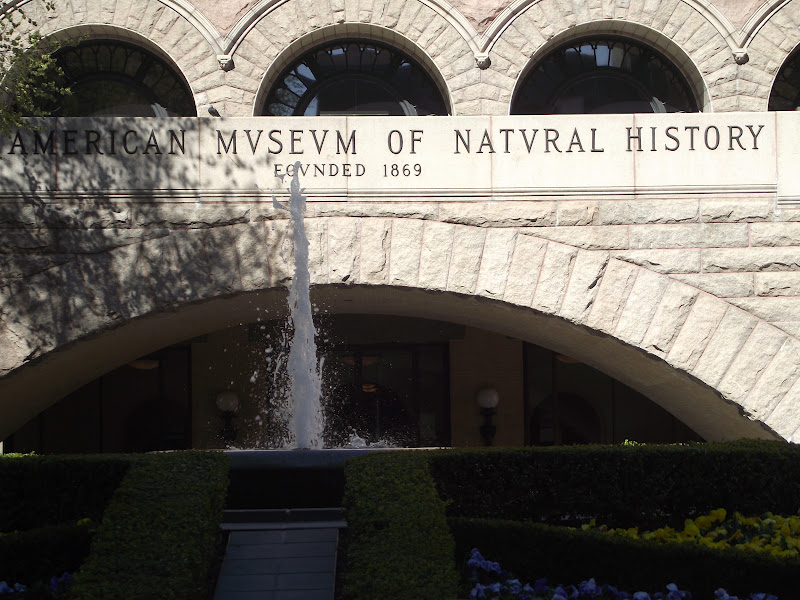
 `Abdu'l-Bahá went to a museum near His house. 
[National History Museum.] On the first floor 
there were statues, figures of animals and a 
collection of relics of early American civilization. 
On observing these objects, `Abdu'l-Bahá said, 
`From these things it appears that America had 
a great civilization in ancient times.'
In the evening, He spoke to a large number of
 friends and seekers at His home about detachment 
from physical desires and the attainment of everlasting life. Everyone was delighted."

Juliet has a much more descriptive entry about the museum visit. But she says it 
occurred on July 9.  Here's the essence of her description, in my words: 

On July 9 Abdu’l-Baha asked Juliet Thompson to take him to the Museum of Natural 
History, where He seemed more interested in talking outside to an elderly museum 
guard than in seeing the museum’s artifacts. When the man asked if He wanted to 
see more of the museum, Abdu’l-Baha said He was tired of this world and more 
interested in things of the spiritual world. The old man responded with a preference 
for the material world, as it is something known. "But you do not lose it when you 
have attained the spiritual world,” said Abdu’l-Baha. “When you go upstairs in a house
you don't
leave the house. The lower floor is under you."


"Oh I see!" cried the guard, his whole face lighting up. 
Juliet asks: "Why had the Master visited a Museum of Natural History in the hottest 
hour of a blistering July day? Had He instead visited a soul whose need was crying 
out to Him, to open an old man's eyes so that he might see to climb the stairs, to take
 away the dread of death?"

I find this story quite interesting. Apparently Juliet went back to the museum the 
next week, and the man no longer worked there. Her thought was that he had
 passed on. . . . We went there and reflected upon the story & shot videotape. 

(Sorry about the spacing. I can't seem to fix it!) 


New York: The Services of Mírzá Abu'l-Fadl
Mahmud wrote: "A number of friends were waiting for `Abdu'l-Bahá when He arrived with a paper from Mírzá Abu'l-Fadl in His hand. He gave it to us and said, `Read it. It is very interesting.' It was an answer to criticisms of one Siyyid `Abdu'lláh, an enemy of the Cause. These criticisms are themselves more proof of the greatness of the Center of the Covenant than are the praises of the friends. Mírzá Abu'l-Fadl has recorded the very words of this critic in his book.
Although that Siyyid had embraced Christianity, thus retrogressing, he appeals in his pamphlet to the nationalities of the world, even the Zoroastrians and Jews, to cooperate with him in his opposition to the Bahá'í Faith. The English press of Cairo published his pamphlet in the month of Naisan 1912. In his pamphlet, he attributes the success of the Cause to the virtues and perfections of the Center of the Covenant. Below is a passage from the second chapter of his pamphlet:
And when we reflect upon his [the Master's] work and the work of his father, we find a great difference between the two. The foundation laid down by Bahá'u'lláh did not rise except very little. It was not even apparent to the eyes of outsiders. But what has been built upon it by `Abbás [`Abdu'l-Bahá] since the time of the passing of his father, which does not exceed twenty years, is really striking. We see millions of people of various religions and diverse denominations such as Muslims, Christians, heathens, Buddhists and Hindus drawn and attracted to His Cause from such remote countries as America, Caucasia, Russia, Great Britain and the shore of India.

In the fifth chapter, he wrote: What vast genius, striking intelligence, consummate opulence and tried virtue has enabled `Abbás Effendi to attract multitudes of people from diverse denominations and languages? Even this month he received hundreds of letters from his American friends, supplicating him to visit them. They sent 1,000 guineas to defray the expenses of his journey. He granted their request as he had promised them last year, but sent back their guineas with thanks and apology, saying that it was not his custom to accept such things. Consider this great opulence which was related to me by one of his followers and also spoken of by some Egyptian papers. Look to this virtue and piety which is the cause of love and affection as is said by our ancestor, the author of Islamic law: `Be indifferent to what the people possess and the people will love you.'
At the table the Master read this paper and smiled. He remarked that according to the words of the Qur'án, the deniers said to the Messenger of God, `Verily, Thou art an insane one.' But now, according to the words of the deniers of the Cause, `vast genius, striking intelligence, consummate opulence, tried virtue' and the majesty of the Center of the Covenant have become a cause for the attraction of hearts. The preeminence and power of the Cause is established even by the words of its enemies. Today the services of Mírzá Abu'l-Fadl were mentioned repeatedly by `Abdu'l-Bahá."

Interesting, indeed!  Reflecting on the life of the scholar, particularly his role in America and particularly at Green Acre, I find I want to draw closer to him.

from Wikipedia: "Near the end of 1912, Abu'l-Fadl started to become ill, and Aqa Muhammad-Taqi Isfahani was able to move Abu'l-Fadl to his house in Cairo, where he remained until his death on 21 January 1914. After his death, `Abdu'l-Bahá gave a eulogy which can be found in Bahá'í Proofs. Moojan Momen, a Bahá'í historian, states that Abu'l-Fadl possessed a critical mind, and had a complete devotion to the Bahá'í Faith. Momen states that Abu'l-Fadl's writings "show a keen understanding of modern currents of thought remarkable in a man who only knew oriental languages." and was able to apply the Bahá'í teachings to a wide range of different issues. 

"Mírzá Abu'l-Fadl wrote on a wide range of Bahá'í subjects, including extensive amounts of material about the proofs of Bahá'u'lláh's mission. He was consistently praised by the central figures of the Bahá'í Faith and Shoghi Effendi. His papers and letters include a wide range of presentations of the Bahá'í Faith for those of Christian and Jewish backgrounds, and his concepts in the presentation of the Bahá'í Faith continue to be important today. After his death, his papers, including several unfinished works, were taken to Ashqabat, where his nephew lived; many of these papers were, however, lost during the Russian Revolution. `Abdu'l-Bahá once wrote, referring to The Brilliant Proof: "His Honour Mírzá Abu'l-Fadl has written a treatise answering the criticisms of a London preacher. Each one of you should have a copy. Read, memorize and reflect upon it. Then, when accusations and criticisms are advanced by those unfavourable to the Cause, you will be well armed." 


Sunday, July 8, 2012

July 8, 1912 Ascendency of the Spiritual


New York:  Ascendancy of the Spiritual; Two Natures


Mahmud wrote: "After His prayers, `Abdu'l-Bahá called to Him, one by one, the 
friends, old and new, who had assembled at His house. Each had a particular 
request or question. They came into His presence and each had a portion of this bounty. 
Mr Hoar's family was invited to dine at `Abdu'l-Bahá's home. As it was very warm and 
because of His heavy schedule, the Master did not get any rest until the afternoon when 
He went for a walk in a park adjacent to His house. He walks in the park, situated on 
the bank of the river, every day. Mr Moxey described `Abdu'l-Bahá's walks in that park 
in a beautiful poem. [Wonder if this poem exists?]
Several friends came to see the Master in the afternoon. The name of Mr Barakat'u'lláh 
of India was mentioned. `Abdu'l-Bahá said:
This man culls the teachings of the blessed Cause and publishes them in the name of 
Islam in the illusive hope of building an imaginary castle and of deriving some profit 
by deceiving the Muslims. But in the long run he will see nothing but manifest loss.
At the public meeting this evening `Abdu'l-Bahá's talk was on the dual nature of man. 
He said: `There are two natures in man. The realization of human virtues and perfections 
depends on the ascendancy of the spiritual over the animal nature in him.'"

What request or question would we have for `Abdu'l-Bahá? What bounties would (will?) 
we receive from meeting Him?